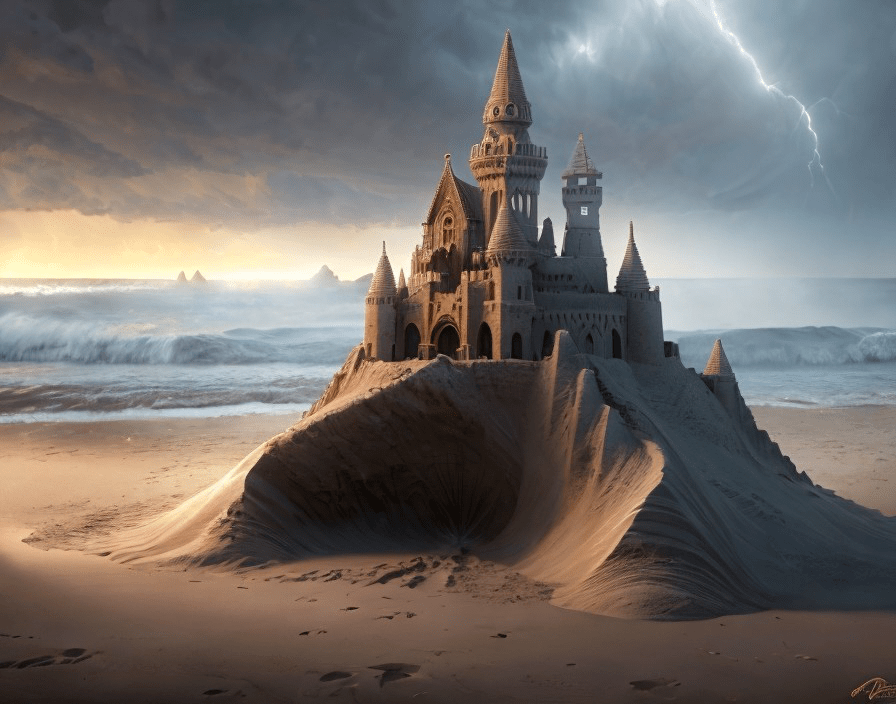
Setting: A quiet, secluded beach at dusk. The sky is a shifting palette of oranges, purples, and deepening blues. The soft, rhythmic sound of waves crashing onto the shore fills the air. Downstage center is a man, Dan, in his 70s. Surrounding him are the tools of his trade: small shovels, brushes, and buckets. The tide creeps closer as the light slowly fades.
Dan (murmuring to himself as he smooths the top of a turret):
Almost there. Just this last piece… There we go. A little more water, just enough to make it hold. (He scoops some wet sand and shapes it carefully.) Funny thing, isn’t it? How something as delicate as this can look so solid, so sure of itself. Like it’s built to last.
(Pauses, wiping his hands on his pants, then steps back to admire the structure. He stands in silence for a moment, the sound of the ocean filling the space.)
It won’t, of course. Tomorrow morning, maybe even tonight if the tide’s impatient, this will all be gone. All those hours—washed away like it never even existed. You’d think a man would lose heart after the first dozen times, maybe the first hundred. But I never did. No… I never did.
(He kneels down again, pressing more sand into a corner, perfecting an archway.)
People would ask me, you know? “Why do it, Dan? Why spend your life on something that won’t even last a day?” Some even tried to stop me from time to time, thought I was wasting my life. The futility of it all, they’d say. Sandcastles are children’s playthings, and you—well, you’re supposed to do something that matters.
(He leans back on his heels, gazing out at the ocean.)
But what exactly is that? Something that matters. Who’s to say? A skyscraper, a painting, a book? Even those—most of them crumble eventually. No, the only difference between a sandcastle and a cathedral is the length of time before the ocean swallows it up.
(He takes a small brush and delicately dusts off some loose sand.)
The tide’s coming in, just like it always does. I’ve had plenty of time to think about that. All the places I’ve been-El Salvador, Thailand, Monterey—they all have tides, you know. The same rhythm. The waves always come. I guess that’s what drew me in, really. Not the castle itself, but the promise that it wouldn’t stay. That I could build it, knowing it wouldn’t last, but build it beautifully all the same.
(He stands, brushing off the sand from his knees. The light is fading more rapidly now, the oranges and purples deepening into blues.)
There’s a kind of freedom in that, in creating something with no expectation of permanence. No audience to impress, no legacy to worry about. Just the joy of doing, of shaping the sand and watching it take form, even if only for a moment.
(Pauses, contemplating the structure before him.)
Legacy. Now there’s a funny thing. People get wrapped up in it, don’t they? Wanting to leave something behind, something that proves they were here, that they mattered. I’ve never been much for that. Maybe that’s why I kept to the beaches, never built anything out of stone. Or maybe it’s because, when you build in sand, you’re honest with yourself from the start. You know it’s not forever.
(He picks up a small stick and begins to carve intricate details into the castle walls.)
We spend so much time trying to fight the inevitable. We shore up our lives, like we can somehow hold back the tide. But that’s the thing, isn’t it? You can’t hold it back. And maybe that’s the point. Maybe the tide’s supposed to come in and wipe it all clean, give us a fresh start. We leave our marks in the sand, and then we let them go.
(Pauses, as if the thought has struck him anew.)
That’s it. That’s the whole beauty of it. The impermanence. The fleetingness. Because if you know it’s going to be washed away, you stop worrying about what it’ll look like tomorrow. You focus on today. On right now. And isn’t that all we really have, in the end?
(The tide draws closer now, its soft roar growing louder. The base of the sandcastle is beginning to darken as the water touches it.)
I’m seventy-three now and I’ve built more sandcastles than I can count. Some of them—if I’m being honest—were probably my best work, gone before anyone else even saw them. But I saw them. I built them. That’s enough.
(He steps back, watching as the water starts to nibble at the edges of the castle. The first turret collapses with a quiet, satisfying crumble.)
We build. We let go. That’s what it means to live, I think. That’s what it means to be human. To know that everything we do is temporary, but to do it anyway.
(A long pause as he watches the waves begin to claim the castle. The soft roar of the ocean grows louder. The colors in the sky have faded into deep blue, the first stars beginning to twinkle.)
(He stands, brushing off his hands one last time. The tide is now fully surrounding the sandcastle, dismantling it bit by bit. He turns and walks slowly up the beach, the sound of the waves following him as the stage fades to black.)
End
 Essays, Art and Plays by Dan
Leave a comment