Enhancing Creativity with Mind Maps
Mind maps are powerful tools that foster creativity by organizing thoughts and ideas in a visual, non-linear format. Created by Tony Buzan, a mind map starts with a central concept, from which branches radiate, each representing a related idea or topic. These branches can further divide into sub-branches, capturing more detailed thoughts, thus creating a comprehensive visual representation of information.
Cognitive Processes in Mind Mapping
The process of creating a mind map aligns seamlessly with creative thinking. It engages both hemispheres of the brain—the left hemisphere, responsible for logical and analytical thinking, and the right hemisphere, associated with creativity and intuition. This bilateral engagement encourages the brain to make connections between disparate ideas, promoting associative thinking. As ideas branch out visually, the mind is more likely to identify novel connections and insights that might be missed with linear thinking.
Mind Maps in Brainstorming Sessions
Mind maps are particularly effective in brainstorming sessions. For instance, a team working on a new product might start with the product name in the center. From there, branches could represent different aspects like features, target audience, marketing strategies, and potential challenges. Each of these branches can then be expanded further. This method not only captures a wide array of ideas quickly but also visually organizes them, making it easier to see how different ideas interrelate.
Role of Visual Elements in Mind Maps
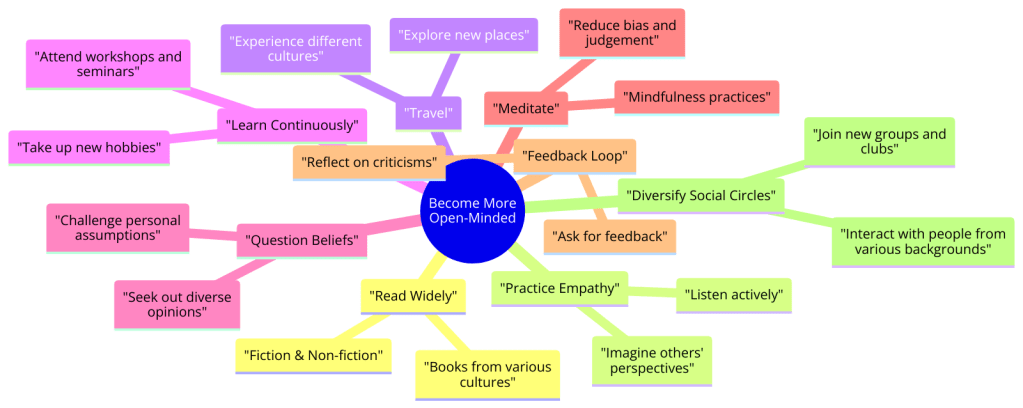
The visual elements of mind maps, such as colors, images, and symbols, significantly enhance creativity. Colors can differentiate categories or levels of information, making the map easier to read and understand. Images and symbols can represent ideas more vividly than words alone, aiding in memory retention and idea association. These visual cues stimulate the brain’s creative centers, leading to more dynamic and inventive thinking.
Case Studies and Anecdotes
Numerous case studies highlight the creative breakthroughs facilitated by mind maps. For example, a software development team at a major tech company used mind maps to overhaul their project management approach. By visually mapping out the project’s components, dependencies, and timelines, they identified inefficiencies and innovative solutions that had previously gone unnoticed. On a personal level, many writers and artists use mind maps to plot stories, develop characters, or brainstorm themes, often finding that the visual organization sparks new ideas and directions.
Advantages Over Linear Note-Taking
Mind maps offer several advantages over traditional linear note-taking. Linear notes often follow a strict, sequential order, which can constrain creative thinking. In contrast, mind maps encourage free association and non-linear thought processes, mirroring the brain’s natural way of working. This flexibility allows for more fluid and expansive idea generation.

Practical Tips for Creating Effective Mind Maps
To create effective mind maps, start with a clear central idea and branch out organically. Use keywords rather than full sentences to keep the map concise. Incorporate colors, symbols, and images to enhance visual appeal and stimulate creativity. Regularly review and update your mind map to reflect new ideas and connections.
Psychological Benefits of Mind Maps
Using mind maps also offers psychological benefits. They reduce mental clutter by organizing thoughts visually, making it easier to see the bigger picture. This organization enhances focus and concentration, as the mind is less overwhelmed by scattered ideas. The act of mind mapping can also be calming, providing a structured yet flexible way to process information and solve problems.
Conclusion
In summary, mind maps are a powerful tool for enhancing creativity. By engaging both hemispheres of the brain, facilitating brainstorming, leveraging visual elements, and offering psychological benefits, mind maps can transform the way we generate and organize ideas. Whether in personal or professional contexts, mind maps encourage a more dynamic and innovative approach to thinking, making them an invaluable asset in the creative process



 Essays, Art and Plays by Dan
Leave a comment